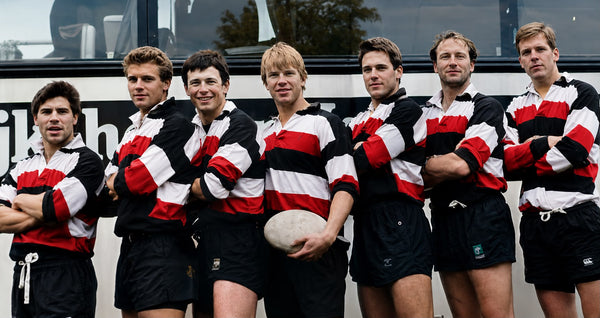
A rugby shirt, often called a rugby polo although the two aren’t strictly the same garment, is a heavy cotton, long sleeved shirt built around a contrasting twill collar, a reinforced button placket and, traditionally, broad horizontal stripes. It was born out of necessity on English club pitches in the nineteenth century, and a hundred years later it quietly became one of the cornerstones of heritage menswear.
From Wool Jumpers to Cotton Armour
Rugby didn’t start with a uniform at all. In the game’s earliest days, players simply turned out in whatever they owned, which made it genuinely difficult to tell one team from another once the ball, and the players, disappeared into a maul of mud, as Rugby365’s history of the shirt explains. As clubs and schools began organising themselves through the 1860s and 70s, teams started wearing matching wool jumpers, the era’s answer to technical fabric and the same material used at the time for swimwear, according to Heddels’ history of the rugby shirt.
Wool, it turned out, was a poor choice for a full contact winter sport. It grew heavy when wet and gave an opponent’s grip something to hold onto. Clubs switched to heavy gauge cotton, and the rugby shirt as we’d recognise it today began to take shape. Every detail on that early shirt earned its place: rubber buttons that wouldn’t tear open skin in a collision, a stiffened twill collar reinforced to survive being grabbed in the scrum, and bold stripes of colour that let a player spot a teammate at a glance, long before numbers were ever sewn onto shirts, as Art of Manliness details in its guide to the rugby shirt.
The Shirt Leaves the Pitch
For most of the twentieth century, the rugby shirt stayed exactly where it belonged: on rugby players, and nowhere else. That began to shift once it found its way onto university campuses. American Ivy League students picked it up through college rugby clubs in the 1950s, and the 1963 film This Sporting Life gave the shirt a rugged, romantic image well beyond the touchline, as noted by Ivy Style’s look at the shirt’s prep school arrival. A young Ted Kennedy was even photographed in one at Harvard in 1955, years before it became fashionable to do so, according to Immortally Preppy’s history of the garment.
It was the 1980s, though, that properly cemented the shirt’s second life. Ralph Lauren took what had been a working class British sports garment and repositioned it for Park Avenue, pairing it with chinos and loafers as a new pillar of American preppy style. From there, its adopters became wonderfully eclectic. Princess Diana wore one off duty in 1997, Mick Jagger paired his with Savile Row tailoring, and by the early 1990s it had crossed into hip hop style too, a shift Thread Harvest traces in detail.
Ralph Lauren, “Rugby Polo” and a Persistent Misnomer
Between 2004 and 2013, Ralph Lauren ran an entire sub label simply called Rugby: bright colours, patchwork detailing and a skull and crossbones “R.L.F.C.” crest aimed at a younger customer, as Wikipedia’s entry on Rugby Ralph Lauren records. It’s very likely this line, alongside decades of catalogue copy, is why “rugby polo” became the everyday name for the shirt in the first place.
Strictly speaking, it’s an odd pairing of words. A genuine polo shirt was designed for a different sport entirely, with a soft, flat collar built for freedom of movement. A rugby shirt’s stiff twill collar and heavy placket were built for the opposite: grip, contact and abuse, as Taylor Stitch’s journal points out. The two terms have simply converged in everyday language, to the point where “rugby polo” is now what most people search for and recognise. We use it too, because that’s how our customers actually talk about the shirt, while we stay true to the original construction underneath the name.
How Rugby Culture Honours the Tradition
Every Rugby Culture rugby polo goes back to that original nineteenth century brief: heavyweight cotton of 300+ GSM with genuine structure, a proper contrast collar, embroidery that survives the wash and stitching built to last more than one season. Our vintage rugby polos revisit classic club colours and striped designs from rugby’s past, and The Nations Collection brings the Six Nations to the same heritage cut.
We’re not chasing an athleisure trend. We’re continuing a garment that has already proven itself, on pitches and city streets, for well over a century. When you pull one on, the details are the same ones a player would have recognised in 1900; they’re simply cut for a life that now includes far more than the scrum.
FAQ
Is a rugby shirt the same as a rugby polo?
Informally, yes. Most people use the terms interchangeably today. Technically, “rugby polo” is a modern shorthand; the original garment is a rugby shirt, distinct from a true polo shirt in both origin and construction.
Why do rugby shirts have a different coloured collar?
The contrasting twill collar was originally a functional choice. It was stiffer than the rest of the shirt, so it held its shape and resisted stretching when grabbed during play.
Why are rugby shirts striped?
Broad horizontal stripes in club colours let players recognise their teammates at a glance in a crowded, muddy game, long before shirts carried numbers.
When did rugby shirts become everyday fashion?
The shift began on university campuses in the 1950s and 60s, but it was Ralph Lauren’s styling of the shirt in the 1980s that turned it into a mainstream wardrobe staple.
Further reading
- Rugby365: History of the Rugby Shirt
- Heddels: History of the Rugby Shirt
- Art of Manliness: A Man’s Guide to the Rugby Shirt
- Taylor Stitch Journal: The Sporting History of the Rugby Shirt
- Ivy Style: Sporting Life, The Rugby Shirt
- Immortally Preppy: How a Rugby Shirt Became Ivy League Uniform
- Thread Harvest: Rugby Shirts Never Die
- Wikipedia: Rugby Ralph Lauren